
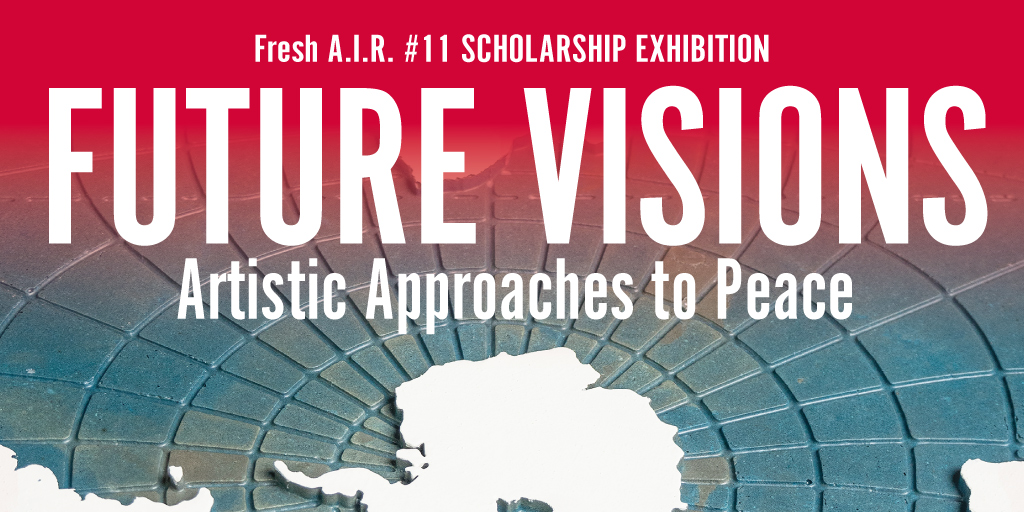
Fresh A.I.R. #11 Scholarship Exhibition
- ARTIST IN RESIDENCE
- Fresh A.I.R. #11
- PROJECT SPACE
- October 31, 2026
FUTURE VISIONS: Artistic Approaches to Peace
On 13 November, 2026, from 7 pm we celebrate the opening of the final Fresh A.I.R. scholarship exhibition. The exhibition showcases the artistic work of 8 scholarship holders from our elebenth Fresh A.I.R. class and of our second recipient of The Martha Cooper Scholarship for documentary photography.
How can we imagine a peaceful future when the foundations of our coexistence are coming under pressure? This is the question addressed by nine artists of the eleventh Fresh A.I.R. cohort. Since February 2026, they have been developing artistic positions under the title FUTURE VISIONS: Artistic Approaches to Peace that explore possibilities for peaceful coexistence and invite us to reflect on how we shape our shared future.
At a time when debates about security, social cohesion, and the future of our society are marked by uncertainty and division, the exhibition turns its gaze toward possible paths to peaceful living together. The works engage with political and social structures, the conditions for lasting stability, and the possibilities of actively shaping the common good. They raise questions about participation, resilience, and mutual support: What helps people remain capable of action in the face of powerlessness? What forms of coexistence can we imagine beyond our familiar notions?
The exhibition invites visitors to explore a range of artistic perspectives and to question their own ideas of a more peaceful future. Some of the approaches presented begin with a shift in perspective, others with new connections or forms of collective action. Together, they open up a space for looking beyond the present and rethinking the possibilities of peaceful coexistence.
Join us for an inspiring exchange of ideas! You are cordially invited to experience the final project results during the public exhibition.
Curator: Janine Arndt, Artistic director at Fresh A.I.R.
Opening event: 13 November, 2026, 7 – 10 pm
Location: URBAN NATION Project Space, Bülowstraße 97, 10783 Berlin
Exhibition period: 14 November, 2026 – 14 March, 2027
Opening hours:
Tuesday + Wednesday 11 am – 6 pm
Thursday – Sunday 1 pm – 8 pm
Closed on Mondays.
READ EVERYTHING ABOUT THE ARTWORKS AND PROJECTS HERE:
About the presented artworks:
3 minutes of nothing to do
Many scientists and philosophers concerned by today’s global crises believe that if we could all pause for a few moments from our frantic daily activities and simply contemplate what surrounds us, giving ourselves more time to think, the world might begin to heal itself from its wounds.
In this experiment, we want to see whether we are able to do this or not.
This is an invitation to become ephemeral monuments to the time we still dedicate to simply thinking:
3 minutes of stillness within the sea of urban agitation.
3 minutes without screens and without pressure.
Simply the experience of inhabiting one’s own existence.
Conceived as a gentle and temporary gesture, it introduces another kind of monumentality:
that of personal presence, opening a space for the transformation of the viewer into the artwork itself.
From admiring external objects of art to becoming a subject of art.
In a world increasingly shaped by acceleration, productivity and constant stimulation, 3 minutes of nothing to do proposes a simple yet potentially radical act:
to stop,
to be,
to think.
Learn more about the project here.
Tell me, Love
Mapping Survival: A Wisdom of Crowds Experiment
BER-2026-2027 / WoC / INT-01
Tell me, Love, where do you want to spend World War III?
Love and war, survival and leisure: catastrophe phrased like a holiday invitation. In a world accustomed to comfort, `spend` makes the unthinkable sound almost ordinary. Perhaps this sweetness is necessary. Societies often silence those who deliver bad news, as if that could change reality. But a warning can also come from care, and even from love.
Beyond its artistic facade, Tell me, Love is a cognitive experiment. The artist is asking her audience for advice, searching for the places where she has the best chance to survive together with her public. Placed in the tradition of Wisdom of Crowds experiments, this project builds on a basic question: can a group of people thinking on their own find a better answer than one person alone? When does a crowd know something that no single individual knows by themselves?
This is a test of cognitive resilience in a fracturing world and an emergent of our collective fears and hopes.
You are invited to make your own independent geographical choice. To keep your answer completely your own, the results will stay hidden until the end of the exhibition, when all individual choices will appear together as points on the map, both online and in the gallery space.
Engage in the experiment here.
Text: Adriana Chiruta
Spaces in between is an ongoing research project in which Amber De Saeger investigates artistic strategies on how to counteract the privatization of public space. During the Fresh A.I.R. residency, Amber deepened her three methodologies: walking as an embodied practice, the creation of minor interventions in the cityscape, and the use of critical cartography. These methodologies are used as a tactic to rewrite the cityscape, creating (in)visible traces in the environment while walking, making interventions and experimenting with mapping.
Within the urban context she is especially interested in places that don’t have a designated function yet and therefore still hold the possibility of change within them, or: spaces in between. As a starting point of her research in Berlin, Amber walked the Wall Trail and traced the 160 km of where Berlin was divided with her footsteps. She did extensive research on local action groups and collectives striving against the living crisis, the ‘Ausverkauf Der Stadt’ and the new surveillance laws, and connected with fellow artists who use similar methodologies to hers. Parallel to this, she attended several seminars on collective and critical cartography, investigating how counter-mapping can be used as a tool to initiate change.
For the exhibition “FUTURE VISIONS: Artistic Approaches to Peace”, she bundled this research in a zine, accompanied by a large sized print of a map. On this map, we see an abstracted version of Berlin, with the walking route along the former wall drawn out. While it is not physically there anymore, the wall can still be perceived as an intangible presence, existing in some form of shadow architecture.
During her walks, Amber noticed the housing crisis was even noticeable in the outskirts of the city, where improvised dwellings and encampments were dotted along the route. The question of who has the right the city became very poignant: who is being included, and who is actively being pushed out of sight? In “Ghosts of the future past” a distorted figure still roams the former death strips, these big stretches of no man’s land laying in between the two walls. If nature would’ve run its course, a fully mature forest would now be growing there. The creature, emerging from the woods and slowly revealing itself, appeals for the right to be
present. When the creature makes its way to the cityscape, the reflective lines on its body deceiving, distorting and confusing the camera, the meaning changes: it calls for the right to be invisible in times we are under constant surveillance.
In these works, Amber plays with the notion of inclusion and exclusion, using the remnants of the past to discuss division in the present. In a time when so many decisions are being taken above our heads, it is about taking back agency, trying to find creative ways of resistance. Or, an exploration on the right to be present versus the right to be invisible.
Thanks to : Susanna Bosch, the fellow participants of the seminar “Kritisches Kartographieren”, the organizers and participants of the critical cartography summer school “Re/drawing Spaces”, Berlin Surveillance and Predictive Policing Research Unit, Lindi Dedek, Don Edler and Alec De Bruyn.
Text: Amber De Saeger
Inner Exile investigates how the human interior retains memory, habit, and a fragile sense of peace when displaced across physical and cultural geographies. For Mourad Fedouache, what began as a field inquiry into belonging became an acute lived reality: systemic administrative hurdles initially delayed his entry into Berlin, and an abrupt refusal of his residency visa renewal forced his return to Morocco. In this convergence of biography and research, exile ceases to be a theoretical category; it emerges as an immediate condition shaped by the friction between the human impulse to take root and the institutional borders that disrupt it.
The exhibition brings together two complementary bodies of work created across Berlin and Morocco:
On the wall is Places We Carry, a participatory project realized in two dialectical chapters. The first took shape in Berlin with members of the Moroccan diaspora, while the second was conducted in Morocco with German expatriates residing there. Bypassing standard photographic portraiture, Fedouache engaged each participant through extended dialogue, inviting them to translate a remembered space of enduring sanctuary onto paper purely through recall. These subjective line drawings; sketches of family courtyards, vanishing streets, or intimate interiors; are physically layered over photographic portraits of their makers. Through this composite technique, facial features and mnemonic topographies merge into a single plane, materializing the invisible architectures people carry within themselves.
Text: Mourad Fedouache
Social discourse has been increasingly polarizing, both online and offline, in our political scenes and the social places we inhabit, shaped by algorithm-driven media, information overload, fragmented narratives and a dramatically decreasing attention span.
You and I: Polarized is a project that explores two dimensions of contemporary affective and ideological polarization, public and private.
In Berlin’s urban spaces, messages collide in an ever evolving dialogue through street art culture: stickers, posters and writings. Not everyone puts one up, but one can rip, scratch, cover, correct and respond.
The artist documented multiple neighborhoods in Berlin, from West to East: Charlottenburg, Schöneberg, Kreuzberg, Friedrichshain and Marzahn. Walking for over a longer period of time the streets in her neighbourhood, she captured public space being claimed and contested, visual conversations unfolding.
What results is a visual archive of a city’s socio-political public discourse – a collage of what stories it considers harmless enough to allow and what it leaves no room for. Anyone is free to interract. At worst though, they can be subject to violence for atempting to remove or cover a message (as reported by Berliner Register).
The private dimension of ideological polarization is a personal retelling of how the artist experiences it in her own family, particularly in relation to her father.
Fueled by a constant instream of political mis- and disinformation, as well as historical revisionist propaganda, she finds her father increasingly over the other side of a deepening rift in romanian society: support for Ukraine and “pro-EU” democratic politics vs. support for Russia and Romania’s resurging far-right parties.
With escalating drone incidents, sunken ships, and attacks near the border, personal political disagreement turns into a feeling of existential threat. Subjects become emotional triggers and dialogue between them gets more and more strained.
How do we make sense of what we still share and what actually threatens it?
“The symbols of today enable the reality of tomorrow. Notice the swastikas and the other signs of hate. Do not look away, and do not get used to them. Remove them yourself an set an example for others to do.”
– Chapter 4: Take responsability for the shape of the world, “On Tyranny”, Timothy Snyder
Text: Anca Maria Gheonea
German artist Lea Gocht was born in Weingarten in 1995 and now lives and works in Karlsruhe. From 2013 to 2020, she studied at the State Academy of Fine Arts in Karlsruhe under Toon Verhoef, Kalin Lindena and Corinne Wasmuht, and became Wasmuht’s postgraduate student in 2021. Among other honours, she received the Graduate Scholarship from the State of Baden-Württemberg (2019), the Prize at the 25th Karlsruhe Artists’ Fair (2022), the Scholarship from the Schöppingen Artists’ Village Foundation (2023) and the Art Prize from the Werner Stober Foundation (2024). In the same year, she was an artist-in-residence at the renowned Cité Internationale des Arts in Paris (2024–2025).
Since 2024, the artist Lea Gocht has been working on an ongoing series of installations entitled anhedonia. The term ‘anhedonia’ originates from clinical psychology and refers to the loss of the ability to feel joy. Drawing on her own critical perspective as a person perceived as female, Lea Gocht extends the concept to encompass collective feelings such as powerlessness, loss of control or the search for agency, which arise in response to societal crises.
Melting Plots is a participatory artistic research project that examines concepts of home, belonging, community, borders, freedom of movement and processes of commoning. The project brought together 43 people from different backgrounds and with diverse biographical experiences. Over several months, interviews, urban walks, and workshops were used to explore how common space can emerge and how solidarity and empathy can contribute to its creation. Through iterative contributions and feedback loops, new spaces of identification emerged, laying the groundwork for creative cooperation in the project’s final phase.
The game of hopscotch, played across generations and cultures around the world, served as a central motif and a tool for exploring notions of borders, territory, occupation, possession, and trespassing. The act of playing helped connect the past and the present, fostering new collective memories and shared realities through reflective and embodied practices.
The process culminated in an image captured in a video performance filmed by drone from a bird’s-eye perspective. The video shown at the exhibition presents the outcome of a process of co-creation in which participants developed new designs and rules for the game of hopscotch, based on reflections from previous activities. Their contributions were brought together to create a stage for the final action: the first collective meeting point in a six-month process, and a practicing for commoning through a playful democratic process.
The accompanying diagrams reveal the underlying architecture of the image, making visible the project’s methodology and the structure of the participant group.
The audio brings together a curated selection of quotes from interviews conducted with participants.*
*The quotes are taken from interviews conducted during the first phase of the Melting Plots project. Participants were invited to share something about themselves and reflect on the concepts of home, belonging, Heimat, borders, and territories. They also responded to excerpts from conversations with other participants whom they had never met in person. In this way, a kind of multilogue emerged, creating a space for exploring points of mutual identification. The exhibition presents a curated selection of quotes from these conversations, re-performed in two neutral voices. The original German quotes have been translated into English and lightly edited for clarity while preserving their original meaning. To respect participants’ different levels of comfort with sharing personal information, some country and place names have been omitted.
Text: Tonka Maleković
Nature is no longer simply something we find; it is, more and more, something we produce. Plants grow in windowless farms under artificial light, meat is cultivated in laboratories, microplastics circulate through living bodies. Autopoietic Singularity takes these present-day shifts as the starting point for a speculative botany.
The work does not mourn a lost, untouched nature. Rather than envisioning ecological catastrophe or utopian harmony, it considers how nature might reorganise under changing conditions, giving rise to forms that unsettle the boundary between the living and the artificial.
Guided by the principle of autopoiesis – the capacity of living systems to regenerate from within – the project draws on what already exists in its immediate surroundings, including matter commonly regarded as waste. Through deconstruction and reconstruction, discarded materials open up new possibilities: here, biomaterials made partly from kitchen leftovers are shaped into sculptures that look like living organisms yet defy easy classification.
Joined with ceramics and wire, they become hybrids – part plant, part mineral, part something not yet named. Their surfaces range from rough, opaque biocomposites to gelatine bioplastics that can turn glossy and translucent, at times resembling both plastic and bark. A QR code leads to the herbarium, where each specimen belongs to the invented genus Futura and is documented like a scientific record: code, subseries, material composition, structure, dimensions, weight. Treating these hybrids with the seriousness reserved for real species, the herbarium builds a taxonomy for the nature that is now emerging.
Each object brings together materials that exist on different timescales: ceramics and metal alongside organic matter that remains responsive to humidity and temperature. Textures, colours and scent may shift over time, extending the work beyond the moment of its making. The objects are not merely representations of hypothetical organisms; change itself becomes part of the work. Here lies its performative dimension – not in action, but in transformation that can only be followed through observation.
In this way, the sculptures propose a different relationship with the art object, grounded in care rather than permanence. They invite a rethinking of what it means to preserve and possess, and suggest the value of being present with matter as it transforms – an attentiveness that extends to the more-than-human world.
Approached with respect, tenderness and a sense of mutual dependence, they point to peace not as a fixed state but as an ongoing pursuit of ecological balance between human and non-human, organic and artificial.
See the whole herbarium here.
Text: Patrycja Pi Pa Piwosz
Peace is usually discussed at a large scale. This project starts from a much smaller one, like two people who don’t understand each other. Many conflicts begin there, when we can’t see things from the other person’s point of view.
City as Map of Ideas is a book of visual exercises to practice changing perspective. Each detail found on the streets of Berlin is paired with an unexpected image.
On the wall, a granite façade with a missing slab hangs next to a man smiling with a missing tooth. Side by side, the hole in the wall starts to look like a gap in a smile, and the smile starts to look a little like a building.
The pairs don’t explain anything. They ask you to look again, from somewhere else.
Text: SerraGlia
Future Perfect Continuous (FUTUR II) explores the field of possibilities within our ecological future. The point of departure of the project is an attempt to deconstruct prevailing geopolitical and chronopolitical framings in response to the global climate crisis. FUTUR II is an exercise in thinking about the ecological future in spatial terms and taking planetary care across time.
The wall installation presented here offers a glimpse of FUTUR II, a cyclical tile work that pictures the multiplicity and simultaneity of possible future worlds. For what lies ahead is not a linear, predetermined and inevitable future, but a multitude of worlds to come, continually unfolding before us in all directions. The path into the future branches fluidly into multiple, interwoven realities. FUTUR II translates this spatiotemporal continuum into an ongoing, multi-perspectival kaleidoscope of planetary visions, bringing lived experience of the present and anticipation of the future closer together.
The underlying form is a world map shaped as an equilateral triangle, based on a projection design developed in the 1960s by New Zealand mathematician and cartographer Laurence Patrick Lee. Unlike, for example, the far more widely known Mercator projection, this map represents the different continents of our globe in relatively balanced proportions. Multiplied and joined together, the triangular map can be extended into an unbounded, interconnected spatiotemporal structure.
The individual map reliefs were cast by hand in ocean-green concrete and painted individually. The visualisations of climate impacts presented in them draw on model calculations from the Climate Impact Explorer, a project by the Potsdam Institute for Climate Impact Research (PIK). The maps illustrate various climate indicators, including heat risk, drought periods and extreme precipitation events, at different points in time (2030, 2050 and 2100) under the respective underlying policy scenarios. FUTUR II connects the past, about which we have accumulated knowledge, and the present, in which we can take action, with the future we choose.
Entering into dialogue with the installation, the thermographic video Reclining Figure presents a smaller-scaled counterpart. It shows the body at rest in a reclining position -or rather, the thermal afterimage left behind by the absent body. The silhouette is animated, quite literally brought to life, and appears to breathe in and out calmly in its sleep. Body heat is a sign of life, and its trace a fleeting inscription of embodied presence. The pneuma of the human body enters into a relationship with the somatic condition of the world, which itself is understood as a living organism.
Text: Simiao Yu
Special Event: OPEN HOUSE @ Fresh A.I.R. + Performances
On 14 and 15 November 2026, the OPEN HOUSE invites visitors to meet the artists in person. Guests gain insights into the artistic processes and working methods, can ask questions, and learn more about the stories behind the artworks. Performances complement the program and open up further ways of engaging with the artistic perspectives on peace and coexistence.
Dates: 14 and 15 November 2026, 4 – 8 pm
Venue: Fresh A.I.R., access via the URBAN NATION Museum, Bülowstraße 7, 10783 Berlin