
Books in the MCL: Michal Škapa: Top to Bottom. Michal Škapa
- Book review by Brooklyn Street Art
- BSA
- Martha Cooper Library
- MCL
- November 2, 2026
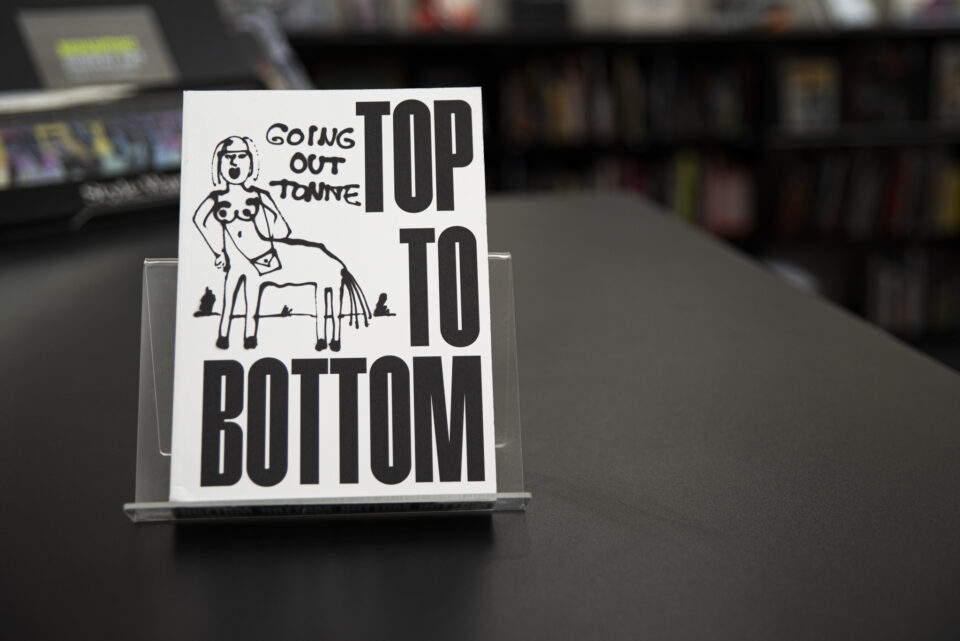
Michal Škapa. Michal Škapa: Top to Bottom. 2021
Michal Škapa’s Top to Bottom, published by BiggBoss in Prague in 2021, is more a catalogue than a book, although it reaches beyond the usual definition of an exhibition catalogue. It chronicles in sketches and photographs the artist’s solo exhibition T2B at Galerie Václava Špály in Prague, where Škapa became the first artist with roots in graffiti to receive a solo exhibition at the gallery. Curator and author Radek Wohlmuth, who began collaborating with Škapa in the mid-2010s, saw the occasion as significant both for the institution and for the recognition of graffiti within Czech contemporary art.
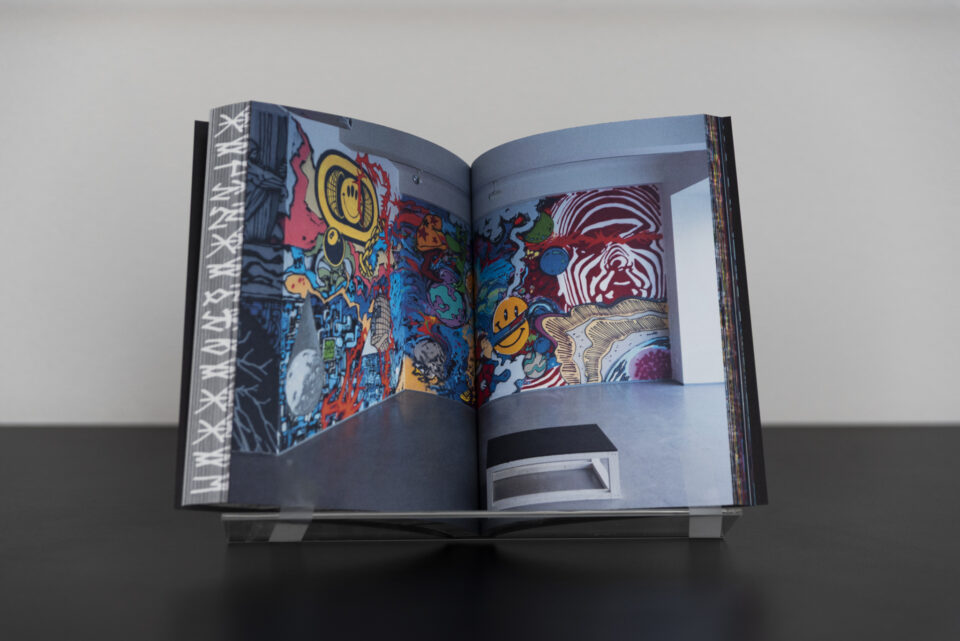
T2B is shorthand for top-to-bottom, an expression from the graffiti vernacular describing a train piece painted vertically from the top to the bottom of the car. Škapa took that principle and applied it to the gallery itself. Forgoing the traditional white-cube exhibition of paintings on canvas hung on white walls, he allowed painting and installation to spread through all three levels of the gallery, treating its architecture as an interconnected canvas rather than simply a container for individual works. In addressing the full dimensions of the gallery, the artist let loose with the same ethos as he would if he were painting illegally on the streets.
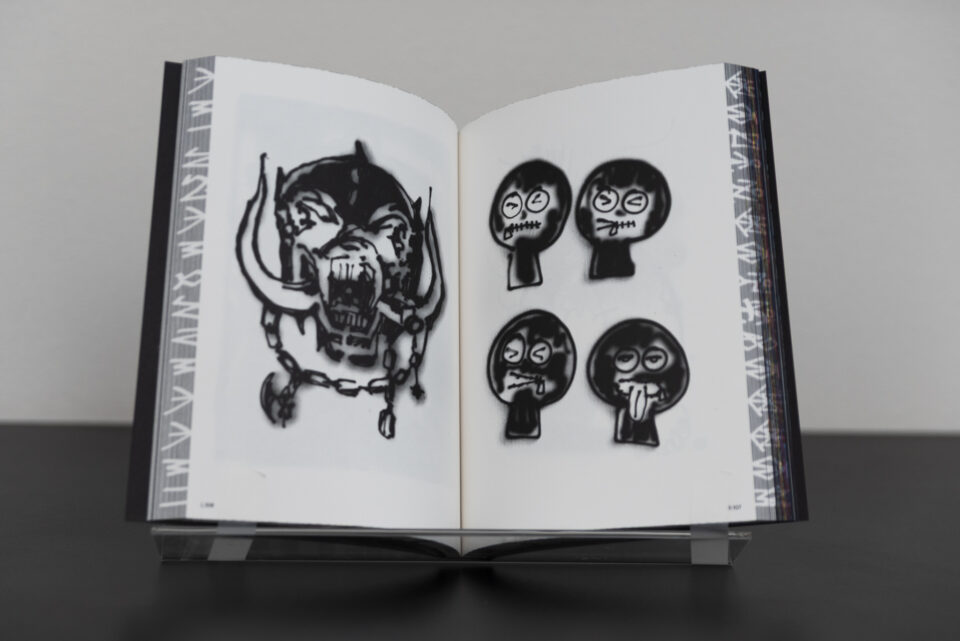
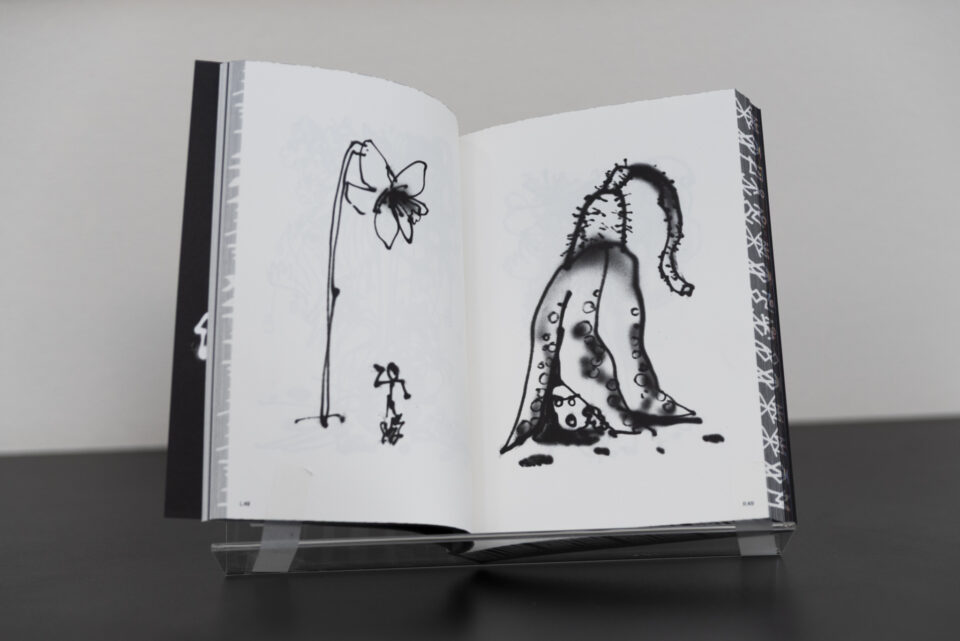
The first part of the catalogue consists of approximately 150 monochrome sketches, followed by photographs showing how dramatically this vocabulary expanded into color once it was released into the gallery. At times the book is reminiscent of a teenage schoolbook or a graffiti writer’s blackbook—sketches and drawings jostle with colored smears, private symbols and pop culture references and experiments in lettering, while complete song lyrics appear typed across the pages. Personal texts, poetry and music are folded into Škapa’s visual language, including the full lyrics to Pink Floyd’s “Time,” Tom Waits’ “Chocolate Jesus,” and Nine Inch Nails’ The Fragile.
Wohlmuth identifies two principal directions running through Škapa’s work: one growing directly from graffiti and the transformation of lettering toward abstraction, the other more representational and drawing freely from comics and cartoons. Together they produce what Wohlmuth calls a world of “urban codes, memes and pop-cultural signs.” It is a useful description for what happens across these pages. The sketches form a restless inventory of interests and impulses before the reader sees them enlarged, layered and set loose across the gallery.
There are handstyles, block letters, skulls, cartoon faces, planets, machines, architectural forms and science-fiction imagery. Recognizable figures collide with abstraction; lettering moves between language and image; marks pile on top of other marks. After encountering the distinctive graffiti writing of São Paulo, Škapa appears to develop an alphabet of his own, further loosening the relationship between what a letter says and what its form can do. The result is not a single signature style so much as a recognizable way of processing the visual world—absorbing things, pulling them apart and returning them in altered form.
Škapa has a voracity for exploring and working with all kinds of mediums that seems almost insatiable: spray can, neon light, ceramics, plastic, glass, brushes, oils, canvases, lithographs, script and his own alphabet, graphics, video projections, sound installations and large murals on walls. Top to Bottom brings many of these interests into the same space rather than separating them into categories. A wall may operate simultaneously as painting, drawing, graffiti and background for a sculptural object. A piece of lettering may remain readable or wander into abstraction. A sketch can grow until it becomes architecture.
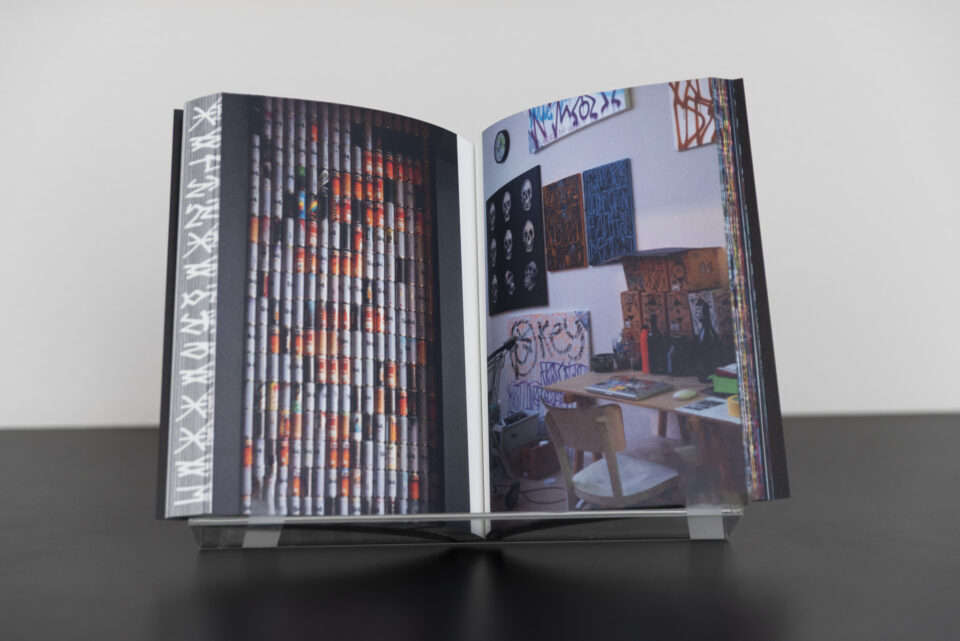
While working on the exhibition and after the opening, Škapa used part of the gallery as his own studio, creating a place not only to make work but also to communicate with peers and visitors. Each day became another addition to the exhibition as the artist continued working within it. The show was not frozen into a finished state on opening night and then placed at a respectful distance from its audience. Production remained visible inside the exhibition itself, loosening the customary separation between studio and gallery, artist and visitor.
The book/catalogue impresses upon the reader the transformative nature of the exhibition as something beyond objects on display for commerce: an almost anarchic presentation of painted walls, neon signs, spray cans, projections, drawings and monoliths arranged like Lego pieces. Yet beneath the apparent chaos are recurring systems—letters, codes, characters, repetitions, grids and layers. The sensibility of graffiti has not simply been carried indoors and hung on a wall. Škapa approaches the gallery much as a writer might approach the city: looking at what is already there, finding its surfaces, occupying them, answering them and changing them.
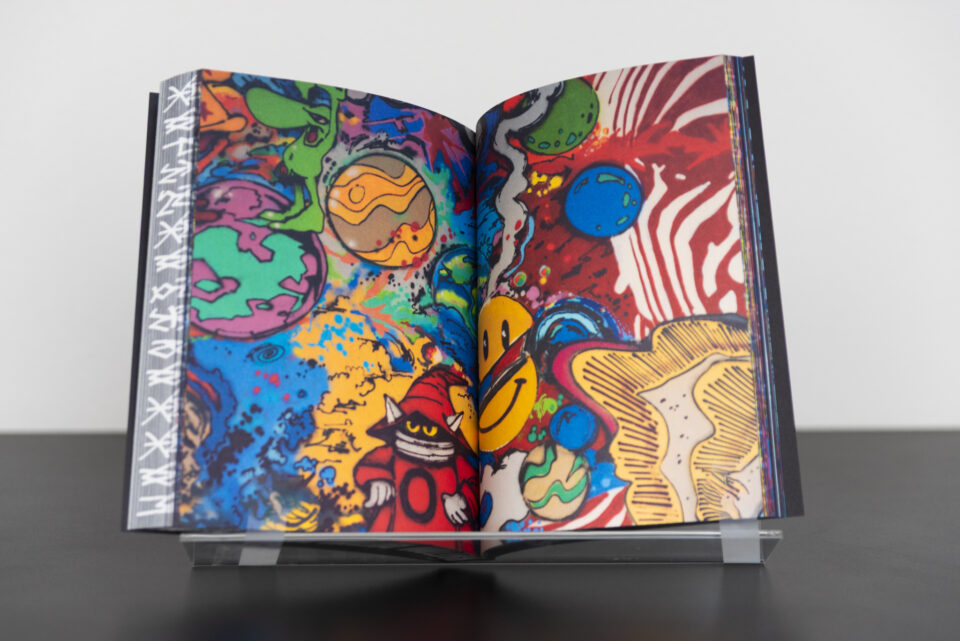
That may be the most interesting achievement of both the exhibition and its catalogue. Škapa sees books and catalogues as a means of preserving events that will not last forever, records of something that will not happen again. Here that idea becomes unusually literal. The exhibition was temporary, and the painted environment disappeared with its conclusion. Portions of the installation were cut from the walls, and versions of the catalogue were offered with pieces of the exhibition itself. The publication was limited to 500 copies.
What remains between these covers is therefore more than a portfolio. The sketches show ideas forming; the photographs show those ideas overtaking a building; and the catalogue preserves the evidence after the physical environment itself has disappeared.
This is Michal Škapa’s world. You’re very much welcomed.
Text Steven P. Harrington and Jaime Rojo Fotos Diana Paun